Wednesday, July 17, 2013

Revealing Mentor's Rock Roots

 
Before I begin, take a second to watch the video. It's OK. I'll wait.

(You might want to put some headphones in. The music might be a little loud.)

Altered Generation helped us kick off our Mentor’s Rock Roots: Celebrating Homegrown Bands concert series last Wednesday at the Read House.

As you probably guessed from its name, the concert series features bands from in and around Mentor.

Tonight, Brendan Burt Band will be playing from 6:30 to 8 p.m. at the Read House.

The series ends with a split performance by Cheap Clone and Hedgehog's Dilemma on July 31.

The concerts are all free and open to the public. They are also sponsored by the Friends of the Mentor Public Library.

I've already talked about some of the reasons why we host concerts at the Mentor Public Library, and there's no need to repeat each one. But there is one reason that bears repetition: It gives us a chance to support local talent.

There aren't a lot of places in Mentor (or even in Lake County) where a young band can perform for their local fans.

That's why we want to give these bands the spotlight they deserve. (And if the concert brings young people to the library who might not visit otherwise, that's great too.)
Altered Generation performs July 9 at Mentor Public Library's Read House.
For more information on concerts and other programs at the Mentor Public Library, visit www.mentorpl.org.

Monday, July 15, 2013

7 Things I Learned About Lake Erie Shipwrecks

Both this shoe and bell were salvaged from shipwrecks in Lake Erie.
Mike Wachter visited the Mentor Public Library Thursday to talk about the many historic shipwrecks there have been Lake Erie.

Mike and his wife, Georgann, have been diving for almost 40 years and have rediscovered 25 wreck sites in Lake Erie. They've also written several books on the subject.

Here are some of seven things I learned from Mike's talk.

1. Lake Erie is incredibly shallow -- the shallowest of all the Great Lakes. It's average depth is 62 feet.

Its deepest point is 210 feet, which is above the water level for Lake Ontario.

2. Its shallowness is one of the reasons so many ships have sank in Lake Erie.

According to Wachter, Lake Erie has had more known shipwrecks per square foot than any other body of water (with the possible exception of the English Channel.)

There are 1,750 documented wrecks in Lake Erie. Wachter knows of at least 300 more and estimates that there are between 2,200 and 2,500 wrecks total.

3. The "holy grail" of Lake Erie shipwrecks is the Marquette & Bessemer #2. It presumably sank while en route from Conneaut to Port Stanley in 1909.

We don't know what caused the steel steamer to crash; because its wreckage has never been found. Some members of the crew washed ashore, none of whom survived; but nothing has been seen of the ship.

"To this day, no one's found it," Wachter said. "For all we know, aliens picked it up and dropped it behind Hale-Bopp."

4. Several ships wrecked during the French and Indian War. During an expedition led by Col. John Bradstreet, 17 of his 59 bateaux -- large, flat-bottomed boats sized between 34-46 feet long -- crashed.

Each of these boats carried about 40 people; so, to make room for these soldiers in his remaining boats, Bradstreet had to bury six of his cannons and a whole lot of his provisions in the area now known as Bradstreet's Landing.
Jean Soboslay checks out a cannonball that Mike Wachter found near Bradstreet's Landing.
Even with the space saved by ditching the cannons, 380 of Bradstreet's soldiers had to march through enemy territory back to Fort Niagara.

5. The most fatal wreck in the history of Lake Erie (and the second most fatal in all of the Great Lakes) was that of the G.P. Griffith in 1850.

Back then, the Great Lakes served as the aquatic equivalent of the Oregon Trail and boats would take immigrants from Buffalo or New York City to Cleveland, Toledo and Detroit.

The steamer departed from Buffalo, N.Y., with German, Irish, English and Scandinavian immigrants aboard. It stopped in Fairport Harbor.

When it stopped in Fairport, the G.P. Griffith was already burning. But its captain was confident that the crew could douse the flames, so it set back out to sea.

The captain's hubris proved fatal. Not only did the fire continue to burn, it scorched the life jackets that were all being housed in the women's formal parlor.

Several of the immigrants jumped overboard in an attempt to swim to safety. However, it was common back then for women to sow their valuables (including gold) into the hems of their skirts so nobody could steal them. Their valuables dragged many of them to the bottom of the lake.

About 290 people died -- a half-mile from shore.

6. While there are hundreds of wrecks in Lake Erie, there is only -- at most -- one treasure ship.

The Atlantic sank in 1852 after it collided with the Ogdensburg. The steamer is rumored to have gone down with a valuable payload, in addition to about 250 of its 576 passengers.

About 140 Norwegian immigrants were on the Atlantic the day it sank, and its tragic end is still taught in some schools in Norway.

7. The package freighter Dean Richmond was another rumored treasure ship after it went down in 1893. (It had set off from Buffalo on Friday the 13th.)

Its manifest said it held "pig lead," which was rumored to be code for gold bars. But, in truth, it was just zinc ingots.

For more information on Lake Erie Shipwrecks, visit Mike and Georgann Wachter's website. For more information on programs and events at Mentor Public Library, go to www.mentorpl.org.


Thursday, July 11, 2013

13 Things I Learned about the Battle of Gettysburg

Rangers and volunteers from the James A. Garfield National Historic Site have been hosting a monthly series of talks about the battles of the Civil War at the Mentor Public Library.

On Wednesday, Park Ranger Todd Arrington talked about the Battle of Gettysburg. The talk corresponded with the battle's sesquicentennial earlier this month.

Here are 13 things I learned from Mr. Arrington:

1. The Battle of Gettysburg is one of the single most studied battles in the world -- not just in America, the whole world.

It's still studied at West Point and it's even studied at the Naval Academy even though it was a landlocked battle that predates the Navy.

2. Gettysburg came on the heels of the Battle of Chancellorsville, one of Confederate General Robert E. Lee's finest hours.

After the loss at Chancellorsville, Abraham Lincoln wanted to replace Major Gen. Joseph Hooker as the head of the Army of the Potomac. But his first choice wasn't General George Meade.

Instead, Lincoln offered the position Major Gen. John Reynolds who declined. (According to Arrington, Reynolds would only accept the job if Lincoln could assure him that he wouldn't have to deal with politicians in Washington second-guessing him.)

With Reynolds uninterested, Lincoln commanded -- not offered, commanded -- Meade to take the lead.

3. Lee had originally intended to invade Harrisburg, Penn. However, he abandoned that strategy when he heard Meade had replaced Hooker.

Lee had more respect for Meade as a general than he did for Hooker -- the two had served together in the U.S.-Mexican War -- and Lee opted for a more cautious strategy.

4. It's a popular myth that the Battle of Gettysburg began because the Confederate Army was looking to commandeer new shoes. Arrington said the story is unfounded.

5. The battle began on July 1, 1863 when Union Brig. General John Buford's cavalry division ran into two large Confederate corps.

The Union held the high ground at McPherson Ridge, but they were badly outnumbered. Making the disparity even worse, the cavalry had to fight unmounted and (because of that) about one-fourth of Buford's 2,100 soldiers were stuck holding the horses instead of engaging in combat.

However, Buford was able to hold the high ground until reinforcements arrived.

6. The aforementioned Reynolds arrived and assumed command of the Union Army. However, he was soon shot and killed.

Then Maj. General Abner Doubleday -- who is often erroneously credited as the inventor of baseball -- took command. Maj. Generals Oliver Howard and Winfield Scott Hancock would also briefly have control of the Army of the Potomac until Meade arrived.

7. Toward the end of the day, Lee ordered his Lt. General Richard Stoddert Ewell to take Cemetery Hill (which was desirable high ground) "if practicable."

Those two words have resonated through history. Ewell ultimately decided that it was not practicable. Some historians have argued that Ewell's predecessor -- Gen. Stonewall Jackson who died from friendly fire during the Battle of Chancellorsville -- would have taken the hill. Moreover, they suggest that possession of that hill could have swayed the outcome of the battle and, perhaps, the war.

But, for whatever reason, the hill was not taken.

8. Let's take a second to talk about Union Maj. General Daniel Sickles III. Sickles was an interesting man. Not only did he kill his wife's lover, he was the first man to be found not guilty for reasons of temporary insanity.

The man who he killed, by the way, was Francis Scott Key's son.

9. On Day 2, Lee attempted a flanking maneuver -- similar to what had done successfully at Chancellorsville. He ordered Lt. General James Longstreet to attack the Union's left flank.

In the meantime, Sickles was stationed at Cemetery Hill but he fancied higher ground along Emmitsburg Road. Against Meade's orders, Sickles advanced -- leaving a hole in the Union line.

However, the plan -- insubordinate or otherwise -- worked. Sickles' soldiers delayed Longstreet and exhausted his ranks so they were not at full strength when they reached Little Round top.

Years after the war, Longstreet himself wrote that Sickles had saved the Union Army.

10. Anyone who's seen Gettysburg or read Killer Angels knows about Col. Joshua Chamberlain and the 20th Maine. They were the extreme left flank of the Union Army. If the Confederates got around them, they could flank the whole army.

The 15th Alabama repeatedly charged up Little Round Top but could not get around Chamberlain's men. Toward the end of the day, the 20th Maine ran out of ammunition and they ended up repulsing the Confederates with a bayonet charge.

Later in his life, Chamberlain said he ordered his troops to fix bayonets but he didn't explicitly order a charge. Instead, the charge happened organically as a matter of necessity (but it did make for a nice scene in the movie.)

Ultimately, Longstreet's men were rebuffed.

11. Lee figured if the Union's flanks were strong, its middle must be weak.

Consequently, he ordered a full-on assault of the Union Army's center on Day 3. It's commonly known as Pickett's Charge.

It required nine brigades -- 13,000 soldiers -- to advance over a mile of uncovered ground while being fired at by Union muskets and cannons.

Lee tried to soften the Union line with artillery attacks and additional flanking maneuvers beforehand, but it did not work. Ultimately, the charge was a massacre. More than 50 percent of the Confederate soldiers in the charge did not survive.

It did not help that several farmers' fences blocked the Confederates' advance and had to be torn down or climbed over.

12. Gettysburg was the largest battle fought on the American continent. About 45,000 soldiers died. (That's a conservative estimate. Some guess as high as 51,000.) Both the Union and Confederacy lost about 22,000 men each. The difference: the Union lost about a fourth of their army; the smaller Confederacy lost about a third.

13. We can't talk about Gettysburg without mentioning the Gettysburg Address.

Lincoln wasn't even the featured speaker at the dedication of the Gettysburg National Cemetery on Nov. 19, 1863. That was Edward Everett. He spoke for more than two hours.

Then, Lincoln stood and spoke 271 words that have not been forgotten since.

The Garfield National Historic Site will return to the Mentor Public Library on Aug. 14. The topic will be the Battle of Chattanooga. You can register for the talk here.

Tuesday, July 9, 2013

Know How to Fold 'Em: Origami at the Library

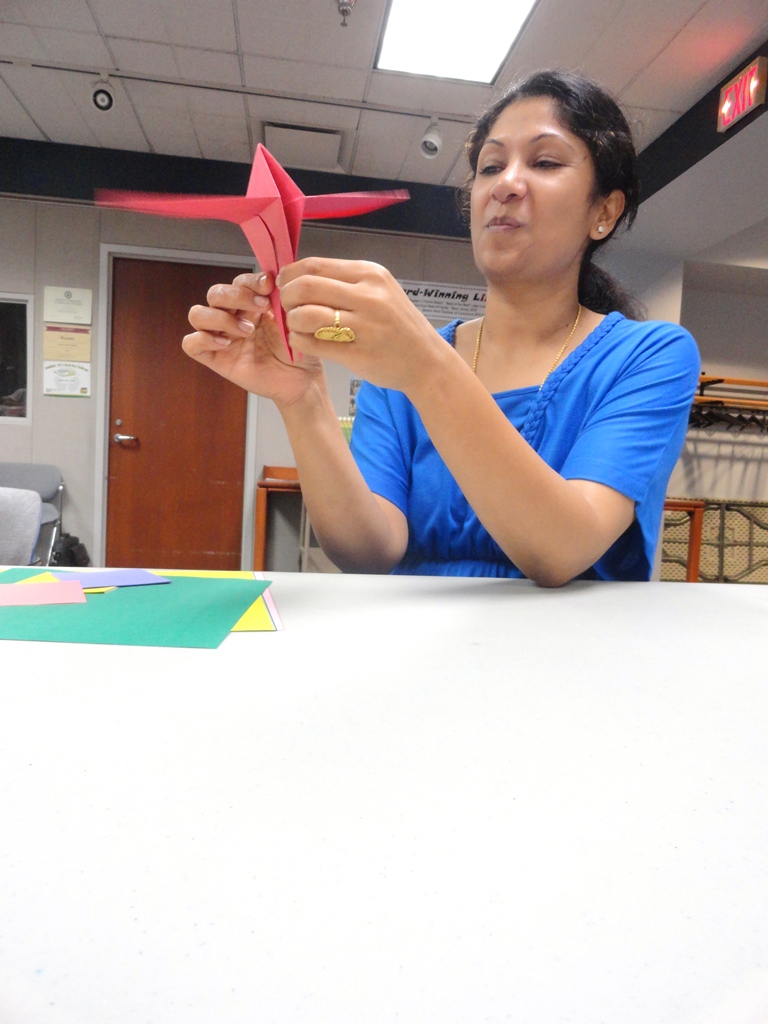
What you're looking at is called modular origami.

At the most basic level, it's a ball within a ball within another ball. Each ball requires 38 individual folds to create.

This is just one of the examples that Jennifer and Mark Cline of the Ohio Paper Shapers (also known as the Ohio Paper Folders) brought with them when they gave a presentation on origami Monday night at Mentor Public Library's Main Branch.

Jennifer showed people how to make cups, pinwheels, bullfrogs, butterflies and cranes all from paper.

But, instead of talking about it, how about I show you the pictures?
Darby Leininger makes a butterfly from paper Monday at the library.

Jennifer Cline explains to Raegann Leininger and Amara Pernus how to form the wings of a paper butterfly.
Margarette Heintz checks out a jar filled with glittering paper stars. Jennifer Cline, Monday's speaker, brought several examples of different types of origami.
Dominik Honarvar concentrates on the many folds it requires to make a paper crane with flapping wings.
Leena Malik demonstrates the flapping wings of her crane.
For more information on upcoming programs and events at the library, visit our website at www.mentorpl.org.

Monday, July 8, 2013

Kids' Stuff at the Library: Cosplay, Pool Noodle Games & Hunting for Jewel Fish

More than 1,300 children have already signed up for our summer reading program.

And those kids have already read about 4,500 hours in the last month.

In addition to reading, they also built catapults, met some of Outback Ray's exotic animals and made good use of our karaoke machine.

But they've also done a lot of other cool things that I neglected to post here. (Please forgive me. I've been distracted by the concerts, Little Free Libraries and Cleveland Mafia.)

So allow me to catch up in the most effective fashion -- with photos of awesome kids doing cool stuff.

Who dares challenge Sasori of the Red Sand to a noodle-eating contest?
This is Vince. Vince is awesome for a lot of reasons. First and foremost, Vince is dressed as Sasori of the Red Sand from Naruto. He wore this to the most recent meeting of our Anime Club, the members of which (you may remember) like to get dressed up.

Furthermore, Vince devoured five bowls of Ramen to win one of our noodle-eating contests at the meeting.

The moral: dressing like Sasori gives you powerful, digestive abilities. Also, Vince is awesome.

By the way, teens, if you love anime, our next club meeting is July 27. We'll be making duct tape swords.
Kim Sidorick, our children's services manager, shows a couple of members of our American Girl Book Club how to make a God's eye
Speaking of our clubs, our American Girl Book Club met Julie Albright -- a young girl growing up in the 1970s -- during their most recent meeting last week. They also learned how to make a God's eye.


Jared Hines and Manav Malik search for scarabs, jewels and stoned with hieroglyphs in the backyard of the Read House during the library's Dig Into Egypt program.
During our Dig Into Egypt program, kids tried to catch a jewel fish (like in the Graeme Base book, The Jewel Fish of Karnac.)

They started their search by digging for special stones. Then they traded the stones for tools or won them by playing mancala. Finally, the kids used their tools to go fishing.

In hindsight, it was kind of like Legends of the Hidden Temple -- y'know with fewer palace guards and no Olmec.

We have more photos from the Dig Into Egypt program on our Facebook page, if you want to check them out.
You think croquet's tricky with a mallet? Try it with a pool noodle.
Finally, at last week's Fun Day Monday, kids used pool noodles as paintbrushes, croquet mallets and tic-tac-toe game boards. (It's incredible to see how creative children's librarians can be when coming up with games.)

We host Fun Day Monday every Monday at 1 p.m. in the backyard of The Read House, which is next door to our main branch on Mentor Avenue.

You don't have to register your kids for Fun Day Monday. Just come out and play!

We have a lot more fun programs coming this summer -- activities with fairies and dinosaurs and ninjas. (These are separate programs. We don't have a Fairy Ninja Dinosaur Party on the docket, though that sounds pretty incredible.)

Check out our calendar and see what's coming up. I bet you'll find something your kid will love.

I mean, who doesn't like dinosaurs?

Friday, July 5, 2013

What's Better Than Shakespeare? Free Shakespeare

We at the Mentor Public Library love William Shakespeare's work in pretty much any of its iterations.

So we're always excited when the Cleveland Shakespeare Festival season arrives.

If you haven't heard of the Cleveland Shakespeare Festival, it's a unique experience. Actors from the area perform a pair of the bard's plays in beautiful outdoor locations throughout the region. For free.

And the only thing better than Shakespeare is free Shakespeare.

The festival comes to Lake County this weekend with a performance of Measure for Measure on Saturday, July 6, at the James A. Garfield National Historic Site and The Two Gentlemen of Verona on Sunday, July 7, at Penitentiary Glen.

Both shows begin at 7 p.m.; and they are outside, so it's recommended that you bring a blanket or lawn chairs.

Also -- not to belabor the point -- both are absolutely free.

Shakespeare billed Measure for Measure as one of his comedies, but that classification might be oversimplifying it. It has a darker tone than, say, Taming of the Shrew or Gentlemen of Verona.

The play deals in some lofty issues of: pride, humility, mercy, justice and truth.

Its famous line and overlying theme is, "Some rise by sin, and some by virtue fall."

If you want a primer, Wikipedia's not a bad place to start.

Meanwhile, The Two Gentlemen of Verona is a more straightforward comedy. It's also one of Shakespeare's earliest plays. Some think it was his first.

It features a lot of the tropes and themes that will later become commonplace in Shakespeare's work: issues of loyalty and fidelity, comedic sidekicks and heroines dressing as men. (Cross-dressing has long been a staple of British humour.)

So see one of the shows. Watch them both. Bring a picnic dinner with you.

Enjoy Shakespeare in some of the most beautiful settings Lake County has to offer.

Tuesday, July 2, 2013

5 Reasons We Host Concerts At Mentor Public Library


The Sunset Country Band is performing a concert Wednesday evening at our Mentor-on-the-Lake Library Branch. It's our way of helping to kick off that long Fourth of July weekend.

Sunset Country Band mixes classic and contemporary country music. If you go to their shows, you'll hear everything from Merle Haggard to Zac Brown Band to Toby Keith.

Here's a short video from when they performed at the Mentor Public Library's Main Branch earlier this summer.


You don't have to register for the concert or anything like that. Just show up, bring a blanket or lawn chair if you like, relax and enjoy the music.

Most people don't associate libraries with live music, though we've been hosting concerts at Mentor Public Library for a couple of years now.

We do it for a lot of reasons. Here are the five biggest.

1. We love music.

Sometimes, it's really that simple. We love music -- all kinds, from jazz to country to pop and back again -- and this is one of the ways we share that love.

It's also one of the reasons we offer Freegal, which is a free and legal way for library patrons to download mp3s, and have stacks upon stacks of CDs for you to borrow.

2. Libraries aren't just places to borrow books. They're cultural centers.

Don't get me wrong. We love books. Most people who work in a library are there, in part, because they love to read.

But libraries aren't just about books.

They're a place to engage with the culture, and culture doesn't end in the written word. It includes music, fashion, art -- pretty much any way a person expresses themselves.

3. It lets us promote local talent.

This July, we're launching our Rock Roots Summer Concert Series.

We're featuring four local bands over the span of three free shows. All four bands -- Altered Generation, Brendan Burt Band, Cheap Clone and Hedgehog's Dilemma -- have roots in Mentor.

This not only gives these bands a chance to perform on their home turf, it also exposes them to a new audience who might not hear of them otherwise.

You can check out our program schedule for more information on our Rock Roots series. The shows are from 6:30 to 8 p.m. on July 10, 17 and 31 -- all Wednesdays -- at the Main Branch.

4. The concerts might introduce you to something new that you'll love.

Mentor Public Library is all about lifelong learning. That's why we host computer classes and programs about the Civil War, origami and spelunking. (And that's just in July.)

That's also why we bring in an eclectic range of performers. We've already hosted jazz and country groups this summer; and we've got alternative, indie pop, oldies and Beatles tribute bands lined up for July and August.

We hope you come to all of the shows. Even if you don't think of yourself as an indie pop or a country fan, you might discover something new to love.

5. The concerts are a lot of fun.

It really is that simple sometimes.